

Transform Your Supply Chain Planning and Marketing Strategies with Google Cloud and SAP Integration
Transform Your Supply Chain Planning and Marketing Strategies with Google Cloud and SAP Integration
March 20, 2026 | Aparna P
Blog / Autonomous AI Agents for Hi-Tech and Semiconductor Supply Chains: Lessons from the Sunnyvale Executive Session
The hi-tech and semiconductor industry operates one of the most complex supply chains in the world. Components move across continents, supplier ecosystems span multiple tiers, and a single delay can disrupt production timelines or product launches worth millions of dollars.
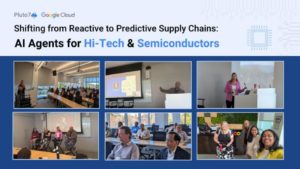
To explore how emerging technologies can address these challenges, Google Cloud and Pluto7 co-hosted an Executive Session on “AI Agents for Resilient and Autonomous Supply Chains” at Google’s Sunnyvale office in California.
The session brought together supply chain leaders, industry practitioners, and technology experts from across the hi-tech and semiconductor ecosystem to discuss how AI agents and agentic AI platforms are transforming supply chain visibility, planning, and decision-making.
The discussion also reflects a broader shift highlighted in Pluto7’s Decade of Impact how organizations are moving beyond traditional planning systems toward AI-driven, autonomous supply chains powered by real-time data and intelligent agents.
Semiconductor supply chains are uniquely complex. Multiple tiers of suppliers, long manufacturing cycles, global logistics networks, and volatile demand cycles make planning both challenging and time-sensitive.
During the Sunnyvale executive session, one theme emerged repeatedly: the biggest challenge organizations face today is not a lack of data—it is decision latency.
Critical information often lives across multiple systems—ERP platforms, planning tools, spreadsheets, supplier communications, and operational systems. By the time teams collect and analyze this information, the situation may have already changed.
In highly sensitive manufacturing environments like semiconductors, even a five-cent component delay can jeopardize a $50-million product launch when decision-makers lack real-time visibility across their supply network.
This is where AI agents for supply chain planning are beginning to play a transformative role.
The executive session featured perspectives from leaders across Google Cloud and Pluto7, including:
Hosted at Google’s Sunnyvale campus, the session provided a forum for industry experts to discuss real-world use cases, lessons learned, and emerging best practices for deploying AI agents in semiconductor and hi-tech supply chain environments.
One of the key takeaways from the discussion was how AI agents differ from traditional automation tools.
According to the speakers, AI agents can understand intent, reason across multiple data sources, and take action within defined business guardrails. This makes them significantly more powerful than traditional analytics or rule-based automation systems.
Many supply chain teams today rely heavily on dashboards and manual analysis to answer operational questions. While dashboards provide visibility, they often still require planners to spend hours gathering and interpreting data before making decisions.
AI agents change this model entirely.
Instead of navigating multiple dashboards, planners can ask questions in natural language, such as:
An AI agent can analyze data across orders, inventory, logistics, supplier commitments, and financial systems and generate actionable recommendations within minutes.
This shift dramatically improves supply chain visibility and planning agility, enabling organizations to respond faster to disruptions and opportunities.
Another key theme from the Sunnyvale session was the importance of a unified data foundation.
AI agents rely on access to integrated enterprise data across multiple sources, including:
When these data sources are unified on modern cloud platforms, organizations can create a real-time supply chain intelligence layer that enables faster and more accurate decision-making.
Without this foundation, even the most advanced AI initiatives struggle to deliver enterprise-scale impact.
Solutions like Planning in a Box – Pi Agent, built on Google Cloud, are helping organizations implement this new model of AI-driven supply chain planning.
Planning in a Box – Pi Agent provides a system-of-intelligence platform designed to enable autonomous decision-making across the supply chain.
Key capabilities include:
Together, these capabilities allow AI agents to analyze enterprise data, model supply chain scenarios, and support real-time decisions across critical operations such as Plan, Source, Make, Deliver, and Return.
By combining Google Cloud’s scalable data infrastructure with Pi Agent in Gemini Enterprise, organizations gain the ability to move toward autonomous supply chain operations.
Another important insight from the Sunnyvale executive session was how AI agents are reshaping the role of supply chain planners.
Rather than spending time manually gathering and analyzing data, planners increasingly act as orchestrators of AI-driven decision systems.
Their role shifts toward:
In this model, planners evolve into what some participants described as “super planners”, working alongside AI agents to guide decision-making across the enterprise.
The discussions at Google’s Sunnyvale office reinforced an important industry reality: AI-driven supply chains are no longer a future concept—they are becoming a competitive necessity.
Organizations that successfully adopt AI agents for semiconductor supply chains will be able to:
For companies operating in complex global supply networks, platforms like Planning in a Box – Pi Agent provide a pathway toward resilient, intelligent, and autonomous supply chain operations.
The Sunnyvale executive session made one thing clear: the next generation of supply chain innovation will be driven by AI agents, unified enterprise data platforms, and real-time decision intelligence.
For hi-tech and semiconductor companies navigating increasingly complex global ecosystems, these technologies offer the opportunity to move beyond reactive planning toward autonomous supply chain management.
And as organizations continue to explore these possibilities, the combination of AI agents, cloud infrastructure, and intelligent planning platforms like Planning in a Box – Pi Agent will play a critical role in shaping the future of supply chain operations.
Interested in continuing the conversation? Let’s connect.
ABOUT THE AUTHOR

Share


Enable Generative AI + Predictive AI On Your Data in 60 minutes.
Add decision intelligence into every corner of your product and operations.